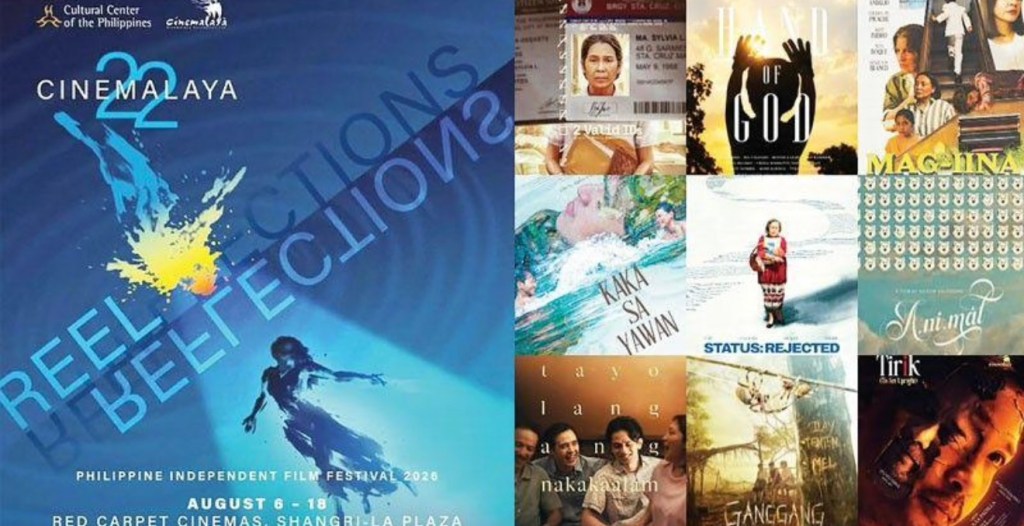
Family secrets? Check. Emotional damage? Absolutely. Two valid IDs? Apparently, even that deserves its own movie.
Cinemalaya 2026 really said, let’s talk about being Filipino, and the stories went everywhere.
The 22nd Cinemalaya Philippine Independent Film Festival wrapped up another edition of fearless Filipino storytelling, with Mag-iina taking home Best Film in the full-length category, Silkscreen winning Best Short Film, and Pokwang and Ruby Ruiz sharing the Best Actress award.
Held from August 6 to 18, 2026, the festival brought together filmmakers, actors, and audiences for 13 days of stories about love, family, identity, grief, power, and the realities we sometimes prefer not to discuss.
And judging by the awards and box-office results, people were paying attention.
‘Mag-iina’ Was the Moment
Some family reunions involve awkward questions and unsolicited advice. Others are straight-up psychological horror.
Mag-iina, directed by Giancarlo Abrahan and written by Guelan Varela-Luarca, took that family tension somewhere much darker.
Exploring three generations of women dealing with grief, dysfunction, and buried secrets, the film emerged as Cinemalaya 2026’s biggest winner with six awards, including Best Film, Best Director, and Best Screenplay.
It also earned recognition for production design, original musical score, and supporting actor Lucas Andalio, who shared the latter award with KD Omalin of Hand of God.
With a cast featuring Janine Gutierrez, Cherry Pie Picache, Agot Isidro, and Jackie Lou Blanco, the film offered more than a conventional horror story. Its family dynamics became a way to explore deeper questions about Filipino society.
Because sometimes the scariest things aren’t supernatural. They’re the secrets people keep at home.
Pokwang and Ruby Ruiz? Two Queens, One Award
One of the evening’s biggest moments came when Marietta “Pokwang” Subong and Ruby Ruiz tied for Best Actress.
Pokwang was recognized for 2 Valid IDs, in which she portrays a struggling farmer confronted by an unforgiving bureaucratic system.
Imagine being unable to access money meant for you because you don’t have the right identification. It’s painfully familiar, and that’s precisely what gives the story its weight.
Ruiz, meanwhile, won for Status: Rejected, a film exploring romance, aging, desire, and the vulnerability of putting yourself out there.
Two performances. Two different women navigating systems and expectations. One shared Balanghai trophy.
And for anyone who still thinks Pokwang belongs exclusively in comedy, this performance offers a compelling reason to reconsider.
The Other Films That Made Their Mark
Tayo Lang Ang Nakakaalam also enjoyed a strong awards night, winning four honors, including Best Actor for Martin del Rosario.
The film centers on love, illness, caregiving, and the emotional reality of a gay man looking after his dying partner. It also won Best Ensemble Performance, Best Cinematography, and Best Sound Design.
Meanwhile, 2 Valid IDs went beyond Pokwang’s acting win, taking the Special Jury Award and Audience Choice Award for full-length films.
Over in the short-film competition, Silkscreen, directed by Rey Anthony Villaverde, earned Best Film for its intimate story about family, craftsmanship, and reconciliation.
Gabriela Serrano won Best Director for Elenita, Elena, Elaine, while RUNO! received Best Screenplay.
Other notable winners included Status: Rejected and The River Flows in Different Places, which received NETPAC awards in their respective categories.
The message across these films was clear: Filipino stories don’t need to fit one genre, one formula, or one kind of audience to make an impact.
So, How Was Cinemalaya This Year?
For its 22nd edition, Cinemalaya embraced the theme “Reel Reflections,” inviting audiences to examine their own experiences through cinema.
The competition featured nine full-length films and ten short films, with screenings at Shangri-La Plaza’s Red Carpet Cinemas and partner venues across Metro Manila.
The festival opened with Enjoy Your Stay, featuring Mercedes Cabral, and presented Rafael Manuel’s Filipiñana as its closing film.
And here’s the interesting part: audiences showed up.
According to festival director Chris Millado, Cinemalaya 2026 had generated ₱18.5 million in local box-office receipts as of August 16, a 47% increase from the previous year’s ₱12.6 million.
That’s not just a win for individual filmmakers. It’s encouraging evidence that Filipino audiences continue to make room for independent films on the big screen.
The awards ceremony also became a platform for filmmakers to address social concerns, including corruption, political dynasties, and development issues.
This wasn’t an edition that kept its conversations safely inside the cinema.
Filipino Cinema Has Stories Worth Showing Up For
What makes Cinemalaya interesting isn’t simply who gets the trophy.
It’s the stories that find space on screen.
A mother struggling with paperwork. A woman searching for love later in life. A family haunted by its past. A queer relationship confronting illness and loss.
These aren’t necessarily the stories that follow the biggest commercial formulas, but they’re recognizable parts of Filipino life.
And perhaps that’s why this year’s festival matters.
In an entertainment landscape where everything competes for a few seconds of attention, Cinemalaya continues to make a case for slowing down, sitting through a story, and actually talking about it afterward.
Because sometimes the most unforgettable plot twist is realizing that the story on screen feels a little too close to home.
And if Cinemalaya 2026 proved anything, it’s that Philippine independent cinema still has plenty to say.
For the complete official list of winners, visit Cinemalaya’s website.
About TheWanderReign
TheWanderReign covers entertainment, culture, lifestyle, travel, and the people and stories shaping contemporary Filipino experiences.


Leave a Reply